Story and game design · In progress
The House by the Road
A psychological horror about guilt, where every clue disproves the comforting lie.
What it is
Vadim arrives by taxi at a mansion in the fog: this is where his eight-year-old daughter Mira went missing. He searches it room by room, and with every find it is harder not to see the truth. Mira and his wife Polina died in a crash. He was driving, drunk. And Vadim himself is lying in a coma, remembering.
The question underneath: can you forgive yourself without lying to yourself?
How it is built
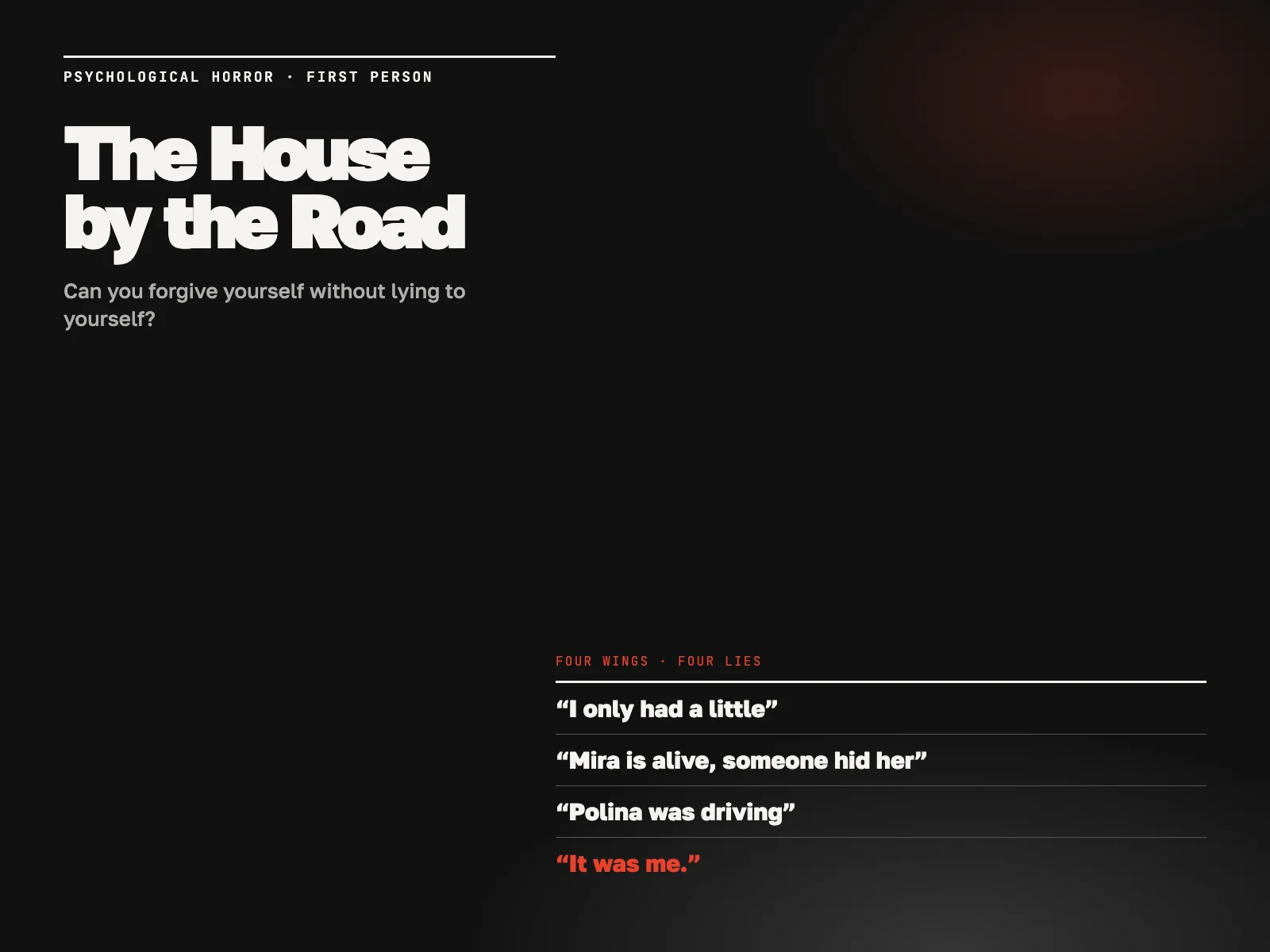
- Each wing is a lie. Every wing of the house is built around a version Vadim comforts himself with — “I only had a little”, “Mira is alive, someone hid her”, “Polina was driving”. The quest is to collect proof, and every piece of proof disproves it.
- The flask. One sip and the house turns warmer and the monster leaves — but the clues blur and the memory rooms lock. A mechanic of dependence with no moral in the text: the player feels how convenient it is to drink.
- Memory as geometry. The worse Vadim remembers a place, the rougher it is. The rooms he won’t let himself think about are grey untextured polygons.
- The crash can’t be avoided. In the last wing the player drives that night and chooses only where Vadim looks in the final seconds.
What I did
Thirteen documents, about 220,000 characters: the project bible, characters, the house and its grounds, structure and quests, the full script of four wings and the finale, lore and notes, a cutscene shot list and a continuity sheet. Five endings, two of them hidden, decided by flags the player sets across the whole game.